Chinese Coin from Saraishyq
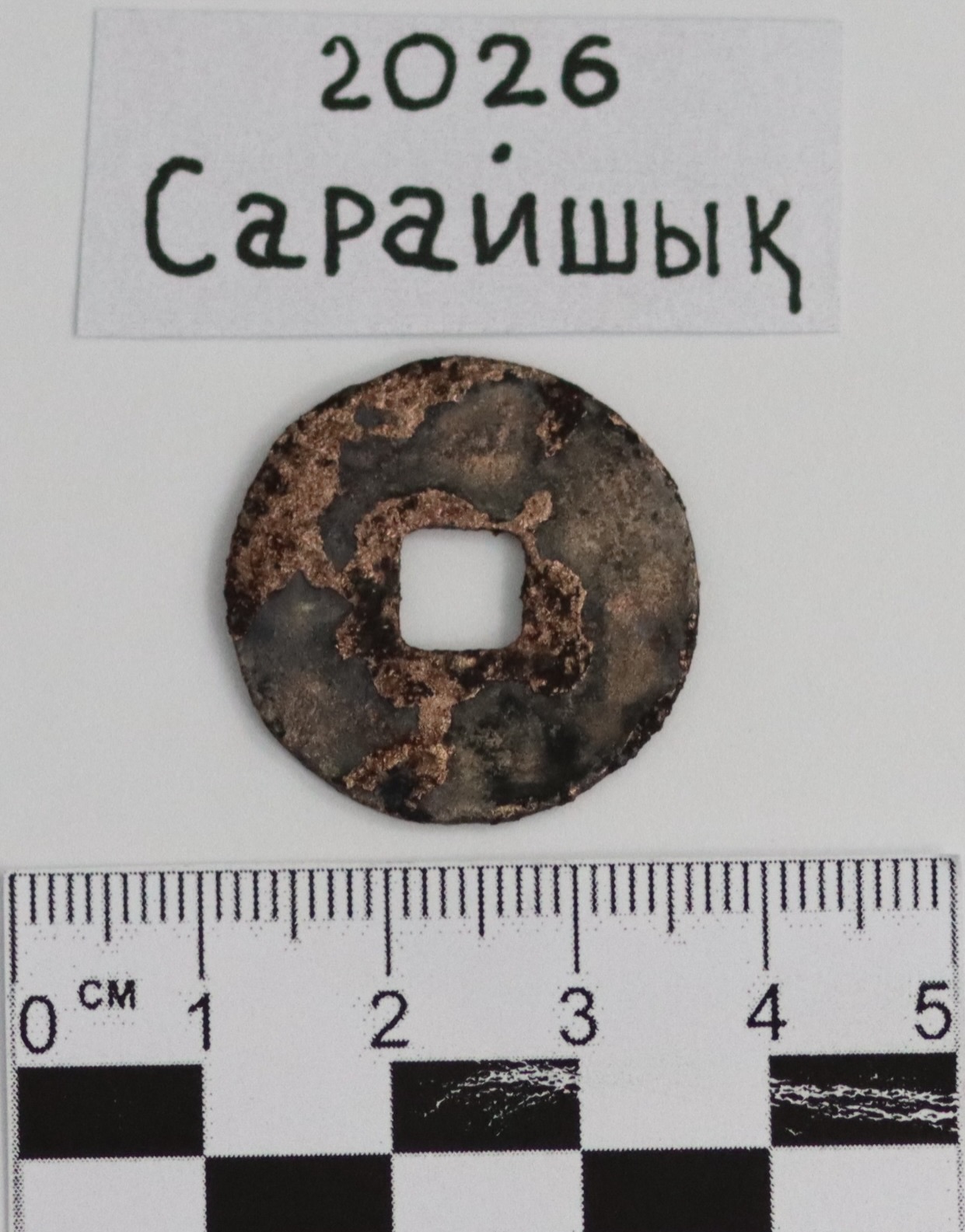
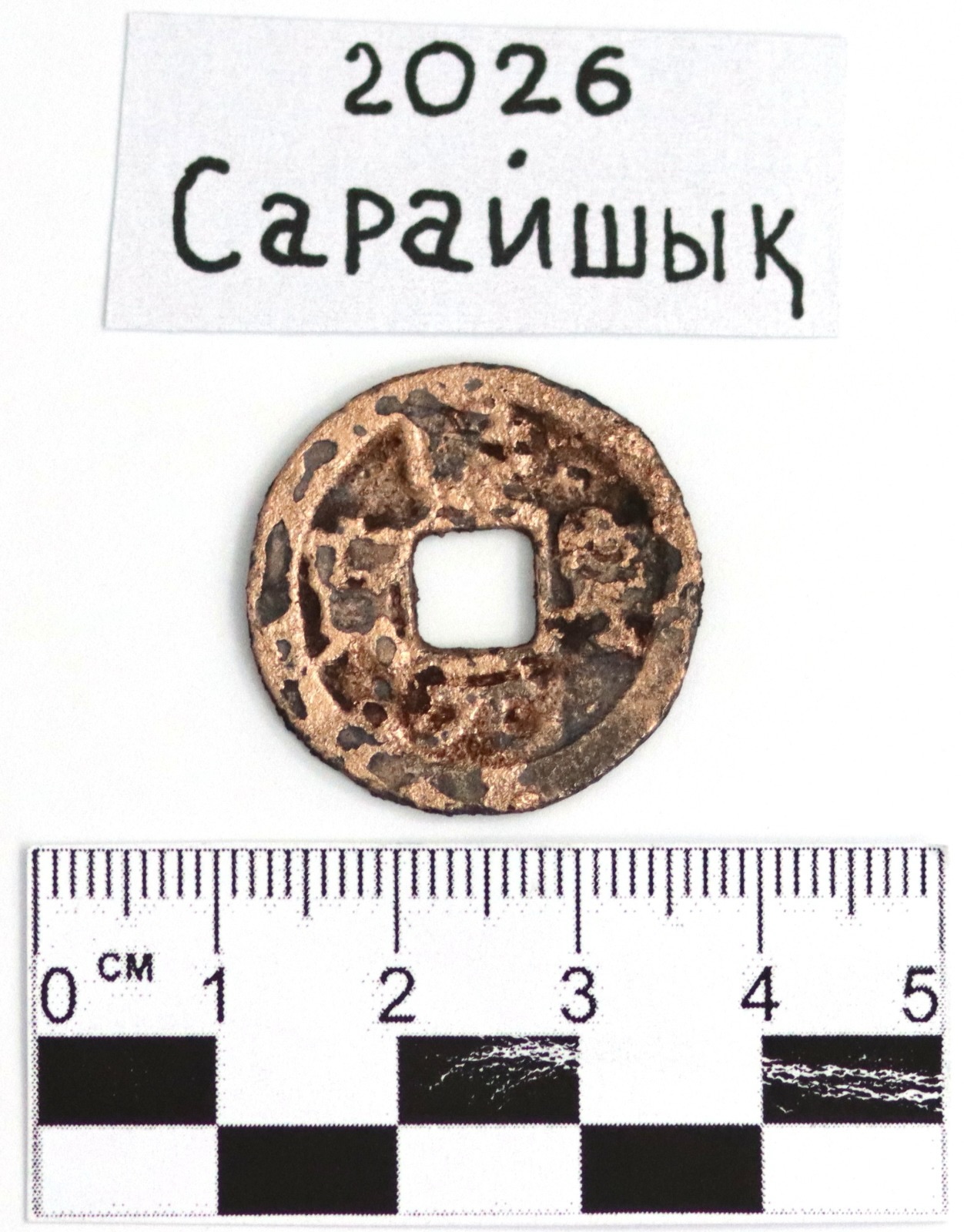
Recently, archaeologists from the “Saraishyq” State Historical and Cultural Museum-Reserve discovered a Chinese coin with a square hole in its center near Excavation Site No. 3 in Saraishyq. This is the first Chinese coin officially recorded among the finds from Saraishyq. In general, such ancient Chinese coins have not previously been found in museum collections across the Atyrau region. However, colleagues have reported (orally) a similar discovery in the Akzhaiyk district of the West Kazakhstan region.
The discovered coin dates back to the Northern Song Dynasty of China. It was minted during the reign of the dynasty’s sixth emperor, Shenzong, who ruled from 1067 to 1085 and is known in history as a reformer. The coin belongs to the early period of his reign, known as the “Xi Ning” era (1068–1077), and is made of copper. It bears the inscription “Yuan Bao,” typical of official state currency, meaning “primary currency” or “circulating treasure.”
The Song Dynasty (960–1279) is recognized in world history as a civilization with a highly developed economy, significant technological achievements, and a flourishing culture. During this period, paper money was introduced for the first time, and major advancements were made in the compass, gunpowder, and printing.
During Emperor Shenzong’s rule, reforms were implemented to strengthen the state’s economy. In particular, great importance was placed on expanding monetary circulation through the large-scale production of copper coins and stimulating trade. Thus, such coins were not only a means of payment but also a clear reflection of the economic policies of the time.
The main route through which Chinese coins reached our region was the Great Silk Road. Merchants transported money along with goods. While such coins may not have been widely used in local circulation, they could have been remelted as metal or used as ornaments and amulets. The central hole made it convenient to string the coin and wear it around the neck.
According to researchers, Chinese coins spread across the Eurasian space to some extent during the Golden Horde period and may have arrived through Mongol conquests. For example, numismatist P. Petrov, studying Chinese coins found in the Otrar region, suggests that the population of the Syr Darya area may have used them in monetary circulation to a certain degree.
Such findings in Saraishyq demonstrate that the city was integrated into the international trade system and actively participated in the economic networks of the Eurasian region.