Historical sites
PANTHEON OF KHANS AND NOGAI BIY
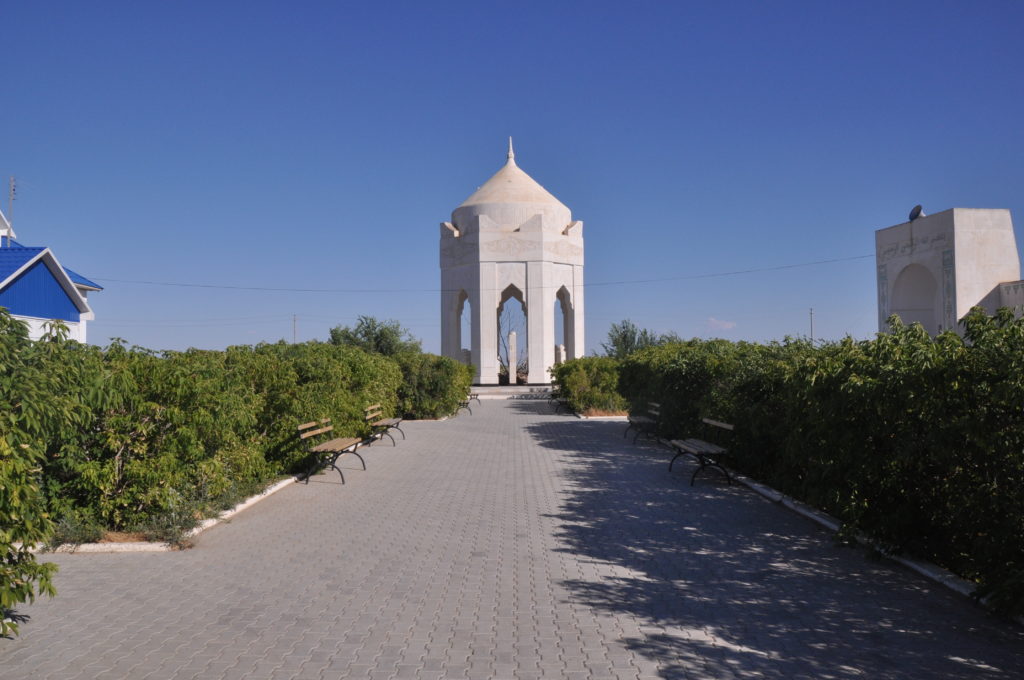
The Khan’s pantheon is an octagonal structure with a height of 14 meters, and copies of tombstones of 4 khans and 3 biys. The names of khans and biys and the period of their reins are carved on black marble stone. The author of the monument is master from Mangystau Sain Nazarbekov. They are made from the Mangistau shell rock. 3 khans of the medieval period of the Golden Horde – Monke Temir, Tokta, Zhanibek, 3 biys of the Nogai Horde – Amir Okas, Shikh-Mamai, Zhusip biy and Kazakh khan Kasym found eternal peace in the Sarayshyk cemetery.
MONKE TEMIR
(1266-1282)
Ruler of the Golden Horde after Batu and Sartak, Olaksha and Monke, grandson of Batu Khan. Under Temir, the Golden Horde acquired the main throne of the Mongols. Without bending to the outer enemies, he achieved self-sufficiency. Ensuring the political independence of Ulus Jochi, he pioneered the issuance of coins with his name on it . During his ruling period, peace and serenity reigned in the western region, and a decree was issued for Russian Tsars, Orthodox confessors, and Genoese and Venice merchants. In 1269, an alliance with the grandson of Ogedei Haiduy was created at the Kurultai on the banks of the Talas River, which served as the basis for ending the differences between the Juchi, Chagatai, and Ogedei uluses. The Golden Horde has strengthened its reputation in the Caucasus and the Volga region. But after that Monke, who replaced Temir, was not able to maintain the position and the power passed to Nogai, and cited disagreement to the Golden Horde.
GIYAS-AD-DIN-TOKTA (TOKTA)
(1191-1312)
He was the great-grandson of Tokta Batu, who ruled for 22 years in the Golden Horde. The Khiva Khan Abulgazy Bahadur wrote about this in his notes, for the first time making annuals of some historiographies of Turkic peoples, about the reign of the Kipchak khan Tokta, its essence and specificity. In 1288, the brothers of the ruler of Tokta were suspicious of his organizational, business skills, and wanted to destroy him by expelling him from the Golden Horde. But a keen mind and political savvy help him to be close to the batyr Nogai without any problems. And Nogai, with the help of Tokta, poaches the rivals of the Horde , and destroys them one by one, and in return puts Tokta on the throne. It was 1290. But the fighting for the throne led the ancestors of Genghis Khan to strife. The reason was that the throne was more important for them than kinship. Perhaps that’s why the Kalmyks say, “a stone has no roots, a ruler has no relatives.” For such reasons, after a while , disagreements begin between Tokta and Nogai. Tokta’s brother Duden invades the territories of Russian princes belonging to Nogai, and in 1300 finally conquers Toktai, and freely disposes of the wide plains between the Volga and the Danube. Despite the unity in the Horde, there were no victories in foreign policy. The body of a descendant of Jochi Khan was buried in the pantheon of Saraishyk.
ZHANIBEK
(1343-1357)
Great personalities such as Zhanibek lived in different periods. Zhanibek, who died in 1342, was the 20-year-old ruler of the Golden Horde, the son of an intelligent and decisive Uzbek khan. Abugazy Bakhadur wrote about him in the «Turkic Chronicles» “Zhanibek was an amazing Muslim khan in Saraishyk. He was a smart, wise man “ . Like all the descendants of Genghis from an young age Zhanibek dreamed of sitting on the throne and came to power by eradicating his brothers Tynibek and Kydyrbek. During his reign in the khanate, Zhanibek emphasized the importance of strengthening the internal and external political position of the Golden Horde and extension of its future borders. in 1357, in order to avoid minor internal disagreements, he sent a thousandth army to Iran. After seizing the lands of Azerbaijan, and shedding a lot of blood in Iran, a large army conquers Tevriz. The authority was handed over to his son Berdibek. Saying goes “like begets like,” Berdibek, not content with the small lands of Tabriz, is plotting against his father an insidious plan to capture the large, spacious lands of the Golden Horde. Not expecting an assassination attempt from his son, Zhanibek will be broken on the halfway to the home. The body was delivered to Saraishyk and buried after a three-day mourning. Berdibek takes reigns . Ruling over the strong state, and not wanting to share the throne with his brothers and relatives, suspecting everyone of confronting himself, one by one people from his inner circle . But the reign of such an insensitive and soulless khan will not last long, and soon he will die.
As mentioned above, Zhanibek emphasized the importance of developing religion in the Golden Horde, improving relations with the Russian people and keeping the sovereignty of each city. He drew attention to the systematization of tax collections and the tightening of discipline.
AMIR OHAS
(14 ..- 1447)
The famous Lame Timur, who after ending his attack in the regions of the Golden Horde, wanted to perpetuate his name, and be the only one in the world destroying everything to the last brick of this Horde. Subsequently, the prosperous Jochi uluses were divided into separate khanates, and Saraishyk became the capital of the Nogai Horde, which was ruled by Edige. In the end, Edige, Nureden, Keyquat, Mansuri for a long time along with others led their power in the old Sarai on the Volga coasts.
The capital moved to Saraishyқ from the moment when the grandson of Edige, the son of Nureden Ohas, sat on the throne of the Nogai Horde . It is worth noting that Khan Ohas Desht-i-Kypshak is a descendant of the Abulkhair Khan (1428-1488). “During his reign the Nogai Horde was probably the part of the union of nomadic Uzbek-Kazakh tribes that Abulkhair ruled. As it can be anticipated, Ohas helps Abulkhair to conquer the throne of Desht-i-Kipchak, and becomes the main adviser. ”-writes about him a prominent writer Abish Kekilbaev. Amir Ohas wholeheartedly helps Abulkhair in the conquest of the Syr Darya, and in 1446 participates in the capture of the city of Uzgent. But then the long friendship of two friends, in a moment, is destroyed to such an extent that they even avoid each other, in the end Ohas dies. In 1447, the “thirty sons of Ohas,” separated from Abulhair, went on to strengthen their positions in the Horde along the Ural. And this was a difficult blow for the Khanate of Abulkhair, as they so far relied on Ohas. Then, the reigning Musa Mahmud, helps Shaibani Khan and opposes the Kazakh Khan Burundyk.
SHIH MAMAI
(1542-1549)
One of the Nogai khans, the relative of Edige, the great-grandson of Nureden, the grandson of Ohas, the third son of the High Biy. He ruled in the eastern part of the Nogai Horde. In 1523,being particularly encouraged, he helped the crimean Khan Mohammed-Grey to conquer Astrakhan. In the end, he fears the strengthening and growth of the Crimean Khanate, and decides to attack him, destroys Khan Batyr and Sultan Paluan. In 1524, the Kazan khan Safa-Gerey fought against the influence of Moscow. He marries the daughter of Shikh-Mamai To strengthen his position in the Nogai Horde. Shikh-Mamai at that time was against the rapprochement of Amir Seydahmet (Seydak) with Moscow. During reigning of Kasim Khan (1511-1520), the Kazakhs were fond of the land on the banks of the Urals, with its vast waters and reeds, but his successor Tagdyr Khan in 1530 received an unforgettable blow from the Nogais. Shikh-Mamai actively participated in this battle and showed himself to be brilliant in the battle. In 1542 he was put on the throne of Saraishyk, and died in 1549.
KASYM KHAN
(1511-1518)
Kasym Khan is the son of one of the founders of the Kazakh Khanate Zhanibek – Khan. In 1511, Kassym Khan received personal power, since that time the reigns of power were held on by Zhanibek’s descendants. Muhammad Sheybani, the conqueror of Maverannahr, several times tried to invade the Kazakh land, striving to prevent the strengthening of the Kazakh Khanate. Soon his army was destroyed, and most of the cities of Turkestan passed under the hands of Kasym Khan. In 1513, the city of Sairam, not far from the Syr Darya, the main areas of Semirechye became the part of the Kazakh Khanate under Kasim Khan government. During his ruling , the border of the Kazakh Khanate reached the right bank of the Syr Darya in the south, covering most cities of Turkestan, in the southeast — most of the Zhetysu steppe, in the north and northeast it expanded under Ulytau to the Balkhash basin, in the northwest to the Ural River basin (Atyrau region completely). Kasym-Khan systematized steppe laws transmitted through generations. “The Way of Kasym Khan” has become one of the prerequisites for the Zhetizhargy Az-Tauke. During the reign of Kassym Khan, the Kazakh Khanate became even stronger and turned into a large and powerful state. The modern territory of our country was formed at that time. According to Muhammad Haidar Dulati, Kazakhs, whose number reached a million, were known to Western Europe as an independent population. From 1517 to 1521, Kasym Khan pursued an active policy in the West of the Kazakh Khanate. Some Nogais join the Kazakhs, and the border reaches the Volga River. According to Russian sources, Kassym Khan died in the winter of 1521. According to Kadyrgali Jalayyr, he is buried in Sarayshyk.
JUSIP
(1549-1554)
Jusip ruled the state at a time when the Moscow state strengthened its power and politics on the banks of the Volga. At this time, when civil strife was growing in the Nogai Horde, Jusip supported cooperation with Muslim countries, and his brother Ismayil tried to establish relations with the Moscow state. This enmity intensified, especially when the Russians conquered the city of Kazan. Zhanalykhan occupying the throne of the Kazan Khanate in 1533 marries the daughter of Jusip, beautiful Suyunbike. Because of the confrontation over the Kazan throne between the “Crimean” and “Moscow groups” and cruel fate of his daughter who ended up in the core of strife, Jusip failed to maintain his political authority. The fall of the Kazan Khanate led to political collapse of Jusip. During this period, the brother of Jusip Ismayl who dreamed of sitting on his throne, defeated the Horde, sit on the throne. Later, the Jusip family was persecuted, and Russians take one of his sons under their protection. In consequence , the famous Yusupov dynasty was created. Thus, destruction of The Nogai Horde started with the fall of Jusip Khan. During the reign of Ismail (1554-1563) in the Horde, hostility and competition do not stop, dark times come. It should be noted that the Kazakh sultan Aknazar Kasymuly, who was sheltered at the time by his wife’s relatives, among the Nogai murzas, in 1569 poached his Moscow ally Murza Tinhamet from Sarayshyk. Since that time, the Nogai Horde lost its unity, one part of people moved to the foothills of the Kap mountains, and the others became the part of the Kazakh Khanate.